
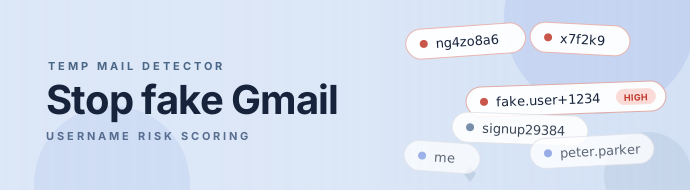
Up until now, people have relied heavily on lists and APIs for detecting disposable email domains. Temp Mail Detector offers exactly that: a service where we analyse and score the domain and tell you if it’s a fake or not. This catches the majority of throwaway email addresses, but not all… Disposable email providers have two ways to hand you a mailbox, which is why we went about creating a model to detect the user part of an email. This means you can now protect your website from disposable Gmail and Outlook addresses by blocking them from your signup flow.
How detecting a disposable Gmail works
The local part check is powered by a model we trained ourselves, on our own labelled data. We’re not making API calls to a third party or using an off the shelf classifier.
Our model can differentiate between a legitimate looking user part of an email and a fake one. Because Gmail and Outlook - or any well known and legitimate email provider for that matter - have a large volume of users, most SaaS companies are too afraid to consider blocking them when it comes to free trial abuse. Temporary email providers know this, so they create free emails with these them and offer plus emails, dots emails, or a time share of a legitimate looking email address.
Detecting a “plus email” or a “dot email” is easy, but how can you detect a random email from a legitimate looking one? This is exactly what we wanted to investigate.
Our model is trained on a large data set we’ve created and tested against the providers we track, as well as those we couldn’t before because they used Gmail. Through (many) iterations and modelling, we’ve slowly created what we think is an accurate model, capable of labelling risky signups.
Rather than giving a score, we provide a low / medium / high risk label. This lets us make updates to the underlying model without our customers needing to modify their thresholds in their code. The below table shows you what this looks like on real data that we’ve tested against:
| Local part @gmail.com | Risk Score |
|---|---|
fake.user+1234@ |
high |
ng4zo8a6@ |
high |
x7f2k9@ |
high |
q7w2e9r4@ |
high |
johnthomas5836ffj7@ |
high |
signup29384@ |
medium |
peter.parker@ |
low |
zeljko@ |
low |
fluffybunny99@ |
low |
me@ |
low |
Paste our prompt into ChatGPT, Claude or Cursor and let it wire up the API for you.
How to work with the risk levels
We would suggest allowing all low risk users, restricting medium risk, and blocking high risk users.
From the above examples, you can get an idea of the wide range of usernames that our model can work with. It won’t always be right, but we’ve trained it to a high degree of accuracy. For example, when testing our model on our own hold-out data (a random sample of real data we’ve collected, but - importantly - haven’t trained on) we see that the high risk band is 98.3% precise with just a 1.0% false-positive rate, meaning a near zero risk of rejecting a real customer. Meanwhile, the medium risk band trades some precision for far wider coverage, resulting in it catching 81% of fakes. It’s for this reason we suggest blocking high risk, but flagging medium risk. Throughout future training, we aim to maintain similar scores or better.
Pairing local part risk levels with domain scoring
A 98% accurate local part model paired with very accurate domain analysis means you now have the ability to detect disposable email providers first by domain, and then by the username.
In most cases, using our standard domain analysis will be enough to identify a fake user or an automated attack, however when there is no domain signal as the sign-up is using a well known email provider such as Gmail or Outlook, you can now fall back to the low / medium / high score as a way of dealing with abusive signups.
How to get set up
Want to act on these signals? We offer you the ability to integrate in minutes using the below easy integration prompt.
Paste our prompt into ChatGPT, Claude or Cursor and let it wire up the API for you.
Have questions? You can contact us at [email protected]