
Most discussion of disposable email blocking focuses on the fraud prevention angle. Less discussed is the privacy question that sits beneath it: when you send a customers email address to a third party API to check if it’s real, what happens to that data?
For businesses operating under GDPR, or building products for European customers, this is not an uncommon concern. It affects how you architect the integration and which providers you can use without creating additional compliance exposure.
This guide covers what GDPR requires when implementing email validation, what the privacy risks of different approaches are, and how to implement disposable email detection in a way that is compliant by design.
The Privacy Problem With Full-Email Validation
Many email verification services perform what is called SMTP verification: they attempt to connect to the mail server for the domain and check whether the specific mailbox (the part before the @) exists. This is technically powerful as it can confirm that [email protected] is a real, active address, but it requires sending the full email address to the verification service.
Under GDPR Article 4(1), an email address is personal data. It identifies, or can be used to identify, a natural person. Sending it to a third party makes that third party a data processor for the email address in question.
‘personal data’ means any information relating to an identified or identifiable natural person (‘data subject’); an identifiable natural person is one who can be identified, directly or indirectly, in particular by reference to an identifier such as a name, an identification number, location data, an online identifier or to one or more factors specific to the physical, physiological, genetic, mental, economic, cultural or social identity of that natural person;
Source: GDPR Article 4(1), eur-lex.europa.eu
This creates obligations:
- You need a Data Processing Agreement (DPA) with the email verification service
- You need a lawful basis for the processing (legitimate interest is the typical justification, but it needs to be documented)
- The processing must comply with data minimisation — you should only send what is necessary
For companies that have gone through a GDPR audit, this typically means email verification services need to be listed in your ROPA (Record of Processing Activities), a DPA needs to be in place, and the processing needs to be justifiable under one of the lawful bases.
The below are the lawful bases for which you can process user data:
| Basis | Article | Legal Text |
|---|---|---|
| Consent | 6(1)(a) | The data subject has given consent to the processing of his or her personal data for one or more specific purposes |
| Contract | 6(1)(b) | Processing is necessary for the performance of a contract to which the data subject is party or in order to take steps at the request of the data subject prior to entering into a contract |
| Legal obligation | 6(1)( c) | Processing is necessary for compliance with a legal obligation to which the controller is subject |
| Vital interests | 6(1)(d) | Processing is necessary in order to protect the vital interests of the data subject or of another natural person |
| Public task | 6(1)(e) | Processing is necessary for the performance of a task carried out in the public interest or in the exercise of official authority vested in the controller |
| Legitimate interests | 6(1)(f) | Processing is necessary for the purposes of the legitimate interests pursued by the controller or by a third party, except where such interests are overridden by the interests or fundamental rights and freedoms of the data subject which require protection of personal data, in particular where the data subject is a child |
Source: GDPR Article 6(1), eur-lex.europa.eu
This is manageable, but it adds compliance overhead. For smaller companies or those in early stages of GDPR compliance, it is one more thing to get right.
The Disposable Email-Specific Approach: Domain-Only Checking
Disposable email detection does not require the full email address. It only needs the domain.
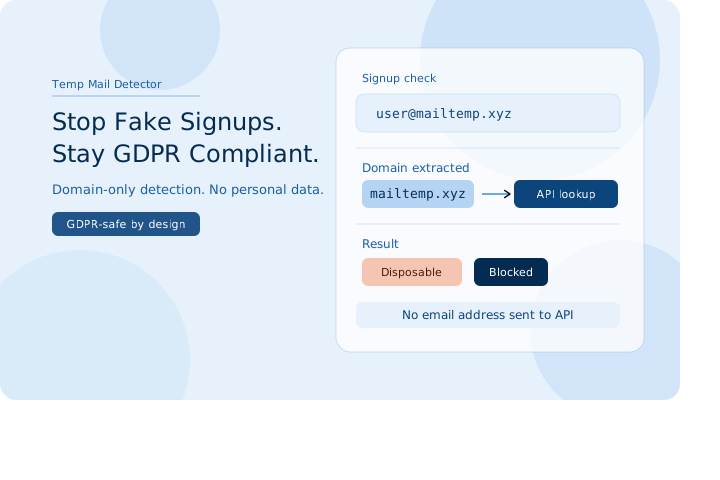
To check whether [email protected] is a disposable address, you extract mailinator.com and check that domain against a database of known disposable providers. You never need to know the user part.
This is architecturally different from SMTP verification and the privacy implications are different too.
mailinator.com is not personal data. It is a domain name, publicly registered, publicly associated with a disposable email service, and not tied to any individual. Sending it to a third-party API for classification does not involve personal data processing. Similarly, sending gmail.com to an api reveals nothing about your users or customers.
This means: - No DPA is required with the detection API provider (no personal data is transferred) - The processing is outside the scope of GDPR’s requirements for data transfer - You do not need to list the detection API as a data processor in your ROPA - There is no issue with data minimisation as only the minimum necessary data is transmitted
This is GDPR compliance by design rather than by documentation. The architecture prevents personal data from being shared, rather than permitting the sharing with contractual safeguards.

What GDPR Requires When You Block a User
Detecting and blocking a disposable email does create a data processing consideration on your side, specifically when you log the rejection.
If you log that a particular email address was blocked, you are processing personal data (the email address) for the purpose of fraud prevention. This is generally justifiable under Article 6(1)(f) GDPR under legitimate interests, but it requires:
- That your legitimate interest (fraud prevention) is genuine and documented
- That the processing is necessary for that purpose (blocking disposable emails is a necessary step in preventing fraud)
- That the interests of the data subject do not override yours (this is usually fine for fraud prevention, but requires consideration)
In practice, the simplest approach is to log the rejection event without storing the full email address: log the domain (not personal data) and a timestamp. This gives you the information you need to monitor your blocking rate without creating a personal data log. This information is then enough to work with to detect an automated attack or free trial abuse.
# Log the rejection without storing the full email
logger.info(f"Disposable email blocked: domain={domain}, timestamp={time.time()}")
# Don't log: email={email}
EU Data Residency
For organisations subject to GDPR Chapter V restrictions on international data transfers (which covers data leaving the EU/EEA to countries without an adequacy decision), the location of your verification API provider matters.
If you send domain data to a US-based API, you are technically transferring data internationally. For pure domain data (not personal data), this is not a GDPR restriction as only personal data is covered. But if you use an API that receives full email addresses, data transfer compliance applies.
Temp Mail Detector operates on EU based infrastructure, with multiple servers distributed across the European Union. This eliminates the international transfer concern entirely, even for services that do pass personal data. It also provides low latency for EU-based users, since requests are routed to the nearest available EU server.
Building a GDPR Compliant Signup Flow
A disposable email check fits naturally into a GDPR compliant signup architecture:
User submits email at signup
    ↓
[Server-side] Extract domain from email
    ↓
Send ONLY the domain to the detection API
    ↓
API returns: score and metadata signals
    ↓
If disposable → reject with user friendly message
If not → proceed with registration
    ↓
[On proceed] Send confirmation email to the user's address
    ↓
User confirms → account created
At no point does a third party receive the user’s email address. The only data sent externally is the domain name. The confirmation email is sent directly from your own email infrastructure to the user’s address.
This is consistent with GDPR’s data minimisation principle (Article 5(1)(c )): only the data necessary for the purpose (domain classification) is processed by the third party.
Privacy Notices: What to Tell Users
Under GDPR, users have a right to know what data you collect and how it is used. If you are implementing disposable email detection, your privacy notice should mention it.
This does not need to be complicated. A brief addition to your registration related disclosures or privacy policy will do. We provide a standard statement which can be used:
“Our website uses TempMailDetector.com as a Data Processor to identify and block temporary or disposable email addresses during sign-up. This helps prevent abuse and is processed under our legitimate interest in maintaining service integrity (GDPR Art. 6(1)(f)).”
If you are using a domain only API like Temp Mail Detector (no personal data transfer), the above is comprehensive. If you use a full email verification service, you will also need to identify the service and reference your DPA with them.

Privacy First Is Also Technically Simpler
The privacy first approach of domain only checking is not just better from a compliance perspective. It is also simpler to implement, safer and faster to run.
Sending only the domain:
- Eliminates personal data handling by the third party
- Avoids the need for a DPA
- Can reduce the risk of false positives caused by SMTP greylisting or temporary mail server unavailability
For any company building products for EU users, this architecture should be the default. The compliance benefits are significant, the technical implementation is identical to full-email approaches (just pass the domain instead of the full address), and the detection accuracy for the specific use case (identifying disposable providers) is just as high.
Temp Mail Detector is built on EU infrastructure, accepts only the domain (never the full email address), and does not store email data. Get a free API key — 200 lookups per month, no credit card required.